
Start here
Cervical pain is one of the most common reasons people come to the Eicher Chowk clinic, and one of the most misunderstood. A great many arrive having been told they have cervical spondylosis, believing that means their neck is wearing out and there is not much to be done.
That is not what the evidence shows. This guide separates the two ideas, explains what cervical pain treatment actually involves, and sets out which symptoms genuinely need a doctor rather than a physiotherapist.
Cervical pain and cervical spondylosis are not the same thing
Cervical pain means pain in the cervical spine — your neck. That is a symptom. Cervical spondylosis is a description of what the discs and joints look like on imaging as they age. That is a finding.
Treating the two as interchangeable is why so many people believe their pain has a structural cause that cannot be changed. The numbers below are the clearest argument that it usually does not.
Out of every 100 adults with no neck pain at all
Spondylosis is what necks do as they age
Four different problems wearing the same name
| Kind of cervical pain | What it feels like | What it usually needs |
|---|---|---|
| Mechanical neck pain | Ache and stiffness across the neck and into the shoulders. Worse with sustained positions, better with movement. No arm symptoms. | The large majority. Exercise, hands-on treatment, position change. |
| Cervicogenic headache | Headache from the back of the head, often one-sided, with a stiff upper neck. | Treating the upper neck joints usually settles the headache. |
| Cervical radiculopathy | Pain in a band down one arm, often with pins and needles, numbness or weakness. | Proper assessment. Most still improve without surgery, but it needs monitoring. |
| Myelopathy or red flags | Both hands affected, clumsiness, balance or walking changes, dizziness, swallowing trouble. | A doctor first. Not a physiotherapy problem to start with. |
What cervical pain treatment involves
- 1
Establish which of the four it is
Everything downstream depends on this. Movement testing, nerve tests where arm symptoms exist, and a check of the red flags above. Twenty minutes settles what a scan often cannot.
- 2
Train the deep neck muscles
The small muscles at the front of the neck that hold your head steady switch off when a neck has been painful. Retraining them is the single most consistent finding in the neck pain literature, and it is unglamorous, low-load work.
- 3
Work the shoulder blades too
The neck sits on the shoulder girdle. Weak lower trapezius and serratus muscles leave the neck carrying load it was not meant to. Treating the neck alone is why some people keep relapsing.
- 4
Hands-on treatment to open the door
Manual therapy to a stiff segment reduces pain enough to let the exercise happen. It works best combined with the active work, not instead of it.
- 5
Fix the thing that keeps provoking it
Screen height, phone habits, pillow, and how long you hold one position. This part is free and most people skip it.
Cervical pain exercises worth starting with
- 1
Chin tuck
Sitting tall, draw the chin straight back without tipping the head. The deep neck flexor exercise, and the one that matters most.
10 reps, 3× daily - 2
Shoulder blade squeeze
Draw both blades down and together, hold five seconds, release.
10 reps, 3× daily - 3
Upper trapezius stretch
Ear towards shoulder, gentle overpressure with the same-side hand. Stop well short of pain.
3× 20 sec each side - 4
Neck rotation, controlled
Turn slowly to each side through a comfortable range. Range, not force.
10 each way - 5
Wall angel
Back to the wall, arms up and down keeping contact. Trains the shoulder girdle that supports the neck.
2×10, daily
What helps less than people expect
- Long-term collar use. Comfort in the short term, weakness and stiffness in the longer term.
- Traction on its own. May ease symptoms during a session, but it does not hold without strengthening.
- Repeat scans. For neck pain without red flags, a second scan rarely changes treatment and often increases worry.
- The perfect pillow. Worth getting roughly right; not worth the search people put into it. Movement variety beats any single position.
- Stopping when it stops hurting. The commonest reason neck pain comes back within the year.
Getting treated in Faridabad
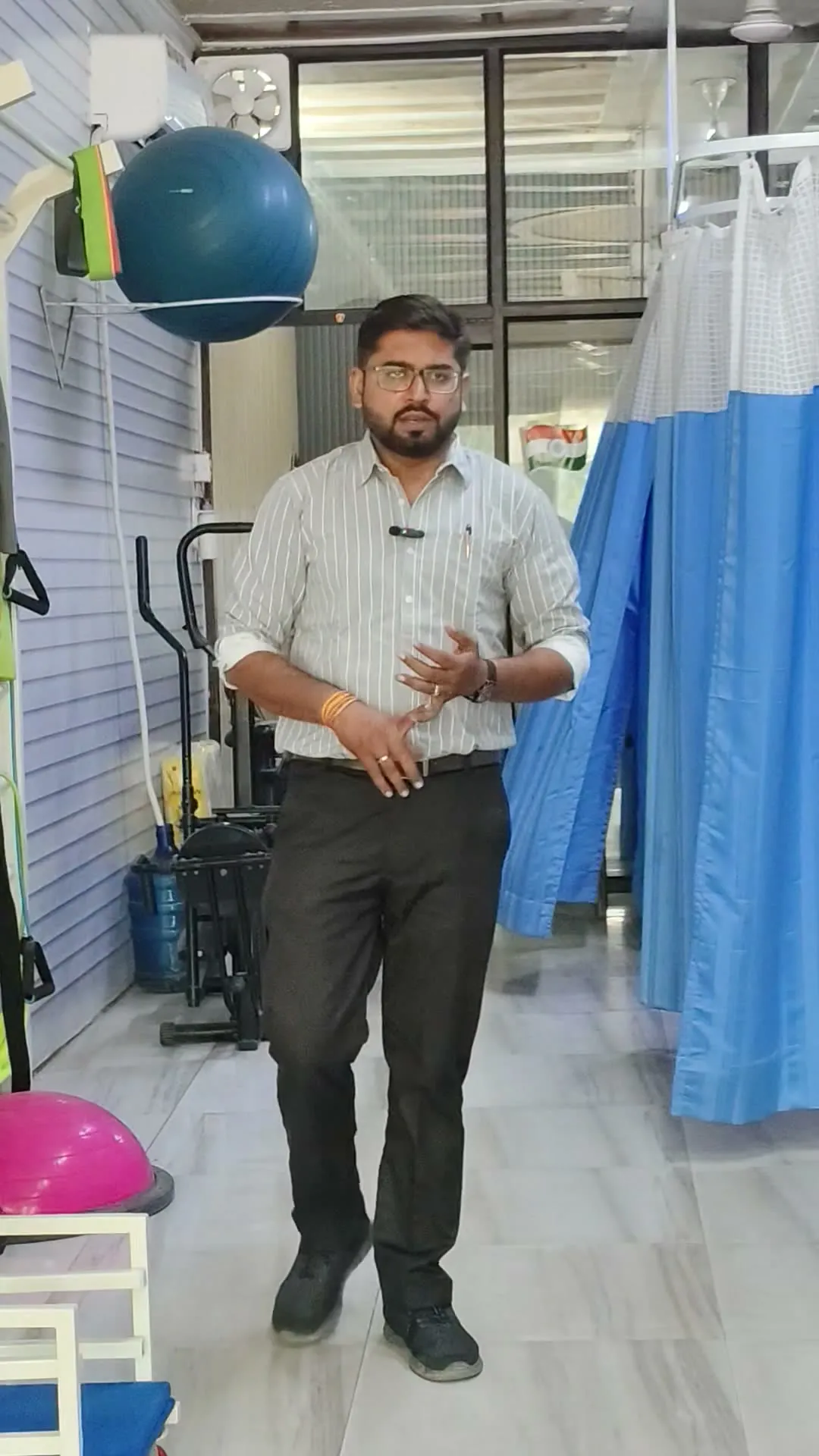
At the Eicher Chowk clinic, assessment and treatment are one-to-one with Dr. Prashant Giri (PT), and you do not need a doctor’s referral to book. Bring any X-ray or MRI reports you have — they are useful context, even though the examination is what decides the plan.
Treatment sits under neck pain and cervical physiotherapy. If your neck pain comes from long screen hours, desk job back pain covers the same posture from the other end. Where the pain is really in the shoulder rather than the neck, read frozen shoulder — restricted movement in every direction points there instead, and it is treated under shoulder and frozen shoulder physiotherapy.
In short
- Cervical pain means pain in the neck. Cervical spondylosis is one possible cause, not a synonym.
- Disc bulging shows on the MRI of 88 in 100 people who have no neck pain whatsoever.
- Most cervical pain is mechanical: tired, stiff, under-strengthened structures, not a damaged spine.
- Exercise for the deep neck and shoulder-blade muscles is the best-supported cervical pain treatment.
- Pain or tingling travelling into the arm with weakness needs assessment, not a stronger painkiller.
- Dizziness, unsteadiness, swallowing trouble or symptoms in both hands need a doctor first.
See a doctor first if you have
- Weakness, clumsiness or wasting in a hand or arm
- Symptoms in both arms or hands, or changes in walking and balance
- Dizziness, double vision, slurred speech or difficulty swallowing
- Severe neck pain after a fall, accident or whiplash
- Fever, unexplained weight loss, or a history of cancer
- Unrelenting night pain that does not change with position
This article is general information, not a diagnosis. If any of these apply to you, please get medical advice before starting exercise or physiotherapy.
Sources and references
- Nakashima H, et al. Abnormal findings on magnetic resonance images of the cervical spines in 1211 asymptomatic subjects. Spine. 2015;40(6):392-398.
- Hogg-Johnson S, et al. The burden and determinants of neck pain in the general population. Bone and Joint Decade Task Force on Neck Pain. Spine. 2008;33(4 Suppl):S39-S51.
- Blanpied PR, et al. Neck Pain: Revision 2017. Clinical practice guidelines. Journal of Orthopaedic & Sports Physical Therapy. 2017;47(7):A1-A83.
- Gross A, et al. Exercises for mechanical neck disorders. Cochrane Database of Systematic Reviews. 2015.