
Start here
Lower back pain is the most common reason people walk into our clinic at Eicher Chowk, and it is the single largest cause of disability in the world. It is also the condition surrounded by the most bad information — about discs, about scans, about rest, and about what "wear and tear" means.
This guide sets out what the research actually shows. It will not diagnose you, because that needs an examination. But it should tell you whether your pain is the ordinary kind that gets better, or the kind that needs a doctor today.
How common is it, really?
More common than almost anyone assumes. A systematic review pooling 97 separate Indian studies found that roughly half the adult population has low back pain at any given moment, and two-thirds will have it at some point in their lives.
Low back pain in India, by how you count it
Globally, low back pain accounted for about 60.1 million years lived with disability in 2015 — a 54% increase since 1990. It is not a trivial complaint that people should simply push through, and it is not a sign that something is uniquely wrong with you.
What actually causes it
Here is the part that surprises people most. In the large majority of cases, no specific structure can be identified as the cause. The medical term for this is non-specific low back pain, and the 2018 Lancet series on low back pain states plainly that a specific cause is rarely identified.
That sounds unsatisfying, but it is actually good news. "Non-specific" does not mean the pain is imaginary or that nothing can be done. It means the pain is coming from the normal structures of the back — muscles, joints, ligaments, discs — being irritated, overloaded or deconditioned, rather than from disease or damage. And that responds well to treatment.
A smaller group has pain with a clear nerve component — what most people call sciatica. A very small group has a serious underlying cause. We will come to how you tell the difference.
The MRI trap: why your scan probably says something alarming
This is the single most useful thing in this guide.
Researchers took 3,110 people who had no back pain at all and scanned them. Disc degeneration, bulges and protrusions turned up constantly — and became near-universal with age. These are people with no symptoms.
Disc degeneration in people WITHOUT any back pain
The three kinds of back pain, and how they differ
Sorting your pain into one of these three groups is the first thing a physiotherapist does, because it changes everything that follows.
Mechanical vs nerve vs serious
| Type | What it feels like | Roughly how common | What it usually needs |
|---|---|---|---|
| Mechanical / non-specific | Ache or stiffness across the low back, often both sides. Changes with position and movement. No leg symptoms. | The large majority | Stay active, hands-on treatment, graded exercise. Scans rarely help. |
| Nerve-related (sciatica) | Pain travelling below the knee, often with pins and needles, numbness or weakness in the leg or foot. | A clear minority | Proper assessment. Most still improve without surgery, but it needs monitoring. |
| Serious pathology | Comes with red flags — see the next section. Fracture, infection, inflammatory disease or malignancy. | Under 1% in primary care | A doctor, not a physiotherapist, as the first step. |
Red flags: when it is not a physiotherapy problem
In a study of 1,172 consecutive patients with acute low back pain in primary care, just 11 people — 0.9% — turned out to have serious spinal pathology, and eight of those were fractures.
Out of 1,000 people with new back pain seen in primary care
Rarity varies with where you are seen, which makes sense — hospitals see filtered populations. Pooled figures put serious pathology at 0.8% in primary care, 2.1% in emergency departments, 4.6% in secondary care and 6.9% in tertiary care.
One caution worth knowing: red flags are sensitive but not specific. In that same study, 80.4% of patients had at least one red flag, yet fewer than 1% had anything serious. A single red flag is a reason to get checked, not a reason to panic. For fracture specifically, only three performed well: age over 70, prolonged corticosteroid use, and significant trauma.
The first decision in any assessment
How long does it actually take to get better?
Honestly? It depends heavily on who is being counted, and this is where a lot of websites quote a number without the caveat.
If you count everyone in the community who gets an episode of back pain — including the many who never seek care because it settles on its own — recovery is fast. The median episode lasts about five days.
If you count only people who went to a clinic or emergency department, recovery is slower, because those are by definition the worse episodes.
Recovered within six weeks — it depends who you count
There is a second, more useful way to look at it: not "recovered or not", but how pain intensity actually falls over a year. Pooled across studies of acute back pain, on a 0–100 scale:
Most of the improvement happens early
A realistic figure for how many end up with long-term trouble: around 13% still have pain at six months, and 19% at two years. Most people do well. A meaningful minority do not, and they are the ones for whom getting the right treatment early genuinely matters.
What actually helps
- 1
Keep moving, and keep working if you can
This is the most consistent finding in the entire literature, and it reverses the advice people were given a generation ago. Bed rest makes mechanical back pain worse, not better. Modify what you do, but do not stop.
- 2
Graded exercise, matched to you
Exercise is the best-supported treatment for persistent low back pain. Crucially, no single type wins — what matters is that it is progressive and that you keep doing it. The best exercise is the one you will actually continue.
- 3
Hands-on treatment, as a door-opener
Manual therapy and soft-tissue work reduce pain and stiffness enough to let you move and exercise. It works best combined with active treatment, not instead of it.
- 4
Understanding what is going on
Knowing that your scan findings are age-normal, and that hurt does not equal harm, measurably changes outcomes. Fear of movement is one of the strongest predictors of pain becoming chronic.
- 5
Sleep, stress and load
Poor sleep and high stress amplify pain. So does a sudden jump in physical demand. These are not side issues — they are often the thing that tipped a coping back into a painful one.
Exercises worth starting with
- 1
Walking
The most underrated treatment for back pain. Rhythmic, loads the spine gently, needs no equipment.
10–20 min daily - 2
Knee rolls
Lie on your back, knees bent, feet together. Roll both knees slowly side to side within a comfortable range.
10 each side - 3
Glute bridge
On your back, knees bent. Push through your heels and lift your hips until your body is in a straight line. Lower slowly.
2×10, daily - 4
Cat–camel
On hands and knees, slowly arch and round your back through a comfortable range. Movement, not stretch.
10 slow cycles - 5
Bird–dog
On hands and knees, extend one arm and the opposite leg. Keep your back still. Swap sides.
2×8 each side - 6
Hip flexor stretch
Half-kneeling, tuck your tailbone under and shift gently forward. Counters long periods of sitting.
3×30 sec each side
What helps less than people expect
- Bed rest. Actively unhelpful for mechanical back pain. It increases stiffness, deconditioning and fear, and lengthens recovery.
- Routine scans. For back pain without red flags, imaging rarely changes treatment — and finding age-normal "degeneration" can make people more fearful and more disabled, not less.
- Long-term painkillers alone. Useful to get you moving in the early days. As a standalone long-term strategy, they treat the symptom and leave the cause.
- Back braces worn constantly. Reasonable briefly in an acute episode. Worn all day, they let the muscles that should be working switch off.
- Waiting for it to pass, past six weeks. The recovery curve flattens after about six weeks. Waiting works early; after that it mostly just costs you time.
What happens at an assessment
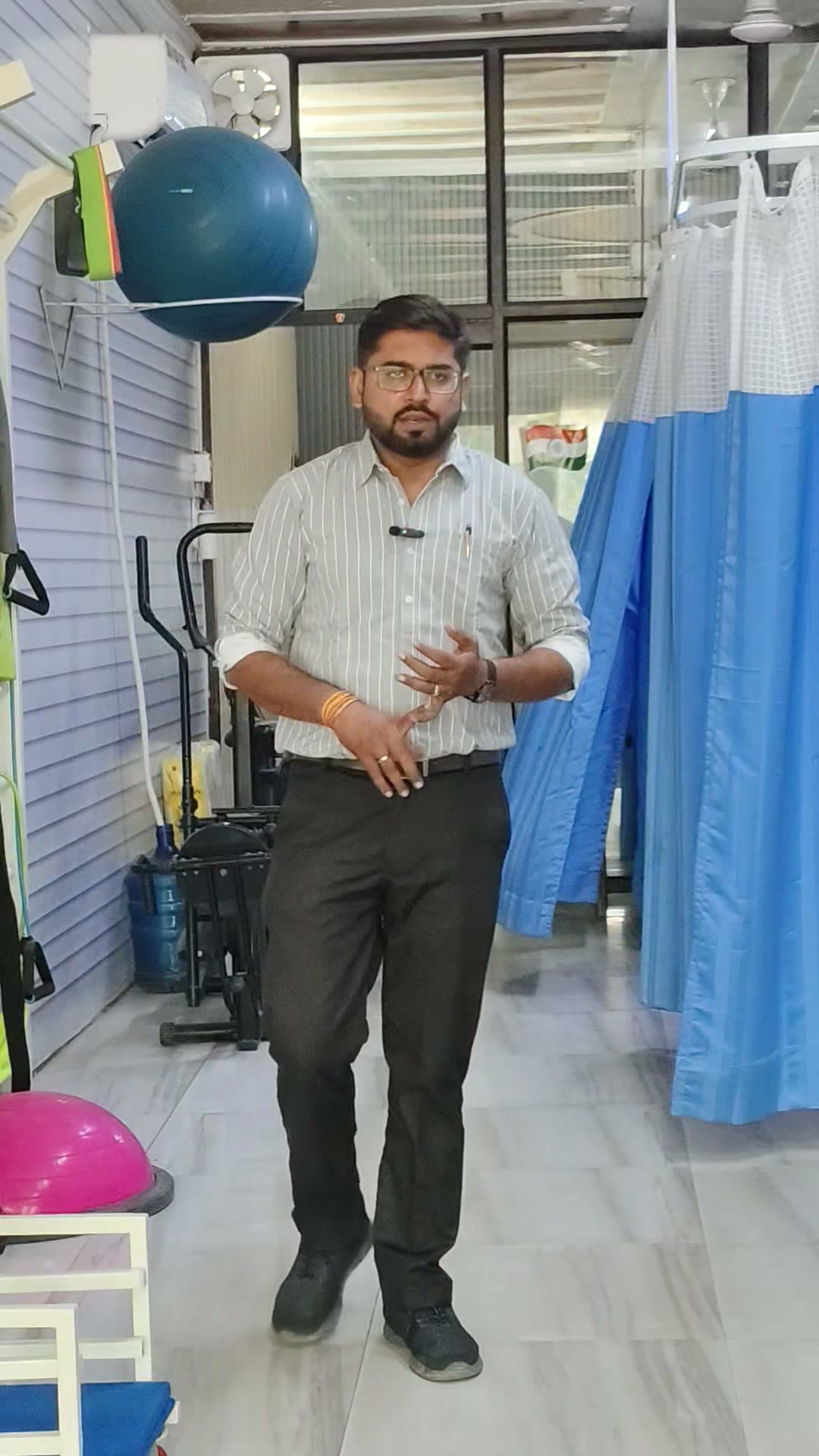
A first visit for back pain should take about 40 minutes and should not start with a machine.
It starts with questions — where it hurts, what makes it better and worse, whether anything travels into the leg, how you sleep, what you do all day, and the red-flag screen. Then an examination: how you move, which directions are restricted or painful, nerve tests if there are leg symptoms, and strength and control testing of the hips and trunk.
You should leave with three things: a plain-language explanation of what is going on, a realistic timeline, and something to do before the next session. If you were handed a generic exercise sheet without an examination, that was not an assessment.
Bring any X-rays, MRI reports or prescriptions you already have. We will read them — in the context of what we find, rather than instead of looking.
Keeping it from coming back
Recurrence is common. The things that reduce it are unglamorous and well-supported: stay generally active, keep some form of strength training going, break up long periods of sitting, sleep properly, and build up gradually when you take on something new rather than jumping straight in.
There is no special posture, mattress or chair that prevents back pain. Movement variety beats any single "correct" position.
Getting treated in Faridabad
At Nirogyam Pain and Physiotherapy Clinic, Eicher Chowk, NIT Faridabad, back pain is the most common thing we treat. Assessment and treatment are one-to-one with Dr. Prashant Giri (PT) — not handed to an assistant — and you do not need a doctor's referral to book.
If you are not sure whether what you have needs a physiotherapist or a doctor, call or WhatsApp and describe it. If it is the second one, we will tell you.
In short
- Around half of Indian adults have low back pain at any given time — you are not unusual.
- Most back pain is "non-specific": no single structure is the culprit, and that responds well to treatment.
- Disc degeneration appears on scans of 80% of pain-free 50-year-olds. Your report is probably describing your age.
- Serious causes account for under 1% of primary-care back pain — but red flags are why screening happens first.
- Pain more than halves in six weeks, then plateaus. Six weeks is the point to get assessed, not to keep waiting.
- Staying active and graded exercise have the strongest evidence. Bed rest and routine scans do not.
See a doctor first if you have
- Pain travelling below the knee with numbness, pins and needles, or weakness in the leg or foot
- Any change in bladder or bowel control, or numbness around the saddle or groin area
- Back pain with unexplained weight loss, night sweats, fever, or a history of cancer
- Significant trauma — a fall, a road accident — or any injury if you have osteoporosis
- Age over 70 with new back pain, or long-term corticosteroid use
- Pain that is constant, unrelenting, clearly worse at night, and not eased by any position
This article is general information, not a diagnosis. If any of these apply to you, please get medical advice before starting exercise or physiotherapy.
Sources and references
- Shetty GM, Jain S, Thakur H, Khanna K. Prevalence of low back pain in India: a systematic review and meta-analysis. Work. 2022.
- Hartvigsen J, et al. What low back pain is and why we need to pay attention. The Lancet. 2018;391:2356–67.
- Brinjikji W, et al. Systematic literature review of imaging features of spinal degeneration in asymptomatic populations. AJNR Am J Neuroradiol. 2015;36(4):811–816.
- Henschke N, et al. Prevalence of and screening for serious spinal pathology in patients presenting to primary care settings with acute low back pain. Arthritis Rheum. 2009;60(10):3072–3080.
- Prevalence of serious spinal pathologies and nonspinal conditions in low back pain: a systematic review and meta-analysis. Pain Medicine.
- The clinical course of acute, subacute and persistent low back pain: a systematic review and meta-analysis. 2024.
- The long-term prognosis in people with recent onset low back pain from emergency departments: an inception cohort study. J Pain. 2021.
- Menezes Costa L, et al. The prognosis of acute and persistent low-back pain: a meta-analysis. CMAJ. 2012;184(11):E613.